EPD_Painter · Endurance test · Live
Bad Apple, run to destruction
It started with a comment on the Bad Apple write-up — someone did the arithmetic and worked out the panel shouldn't last a week.
HaHa says:July 21, 2026Have you driven a display to failure?
IIRC a typical e-ink pixel is rated at about 10M refreshes.
Which isn't a lot of time at 20 fps.
500,000 seconds.
139 hours.
Less than a week.
Tony Weston says:July 22, 2026Im going to do this. Watch this space!
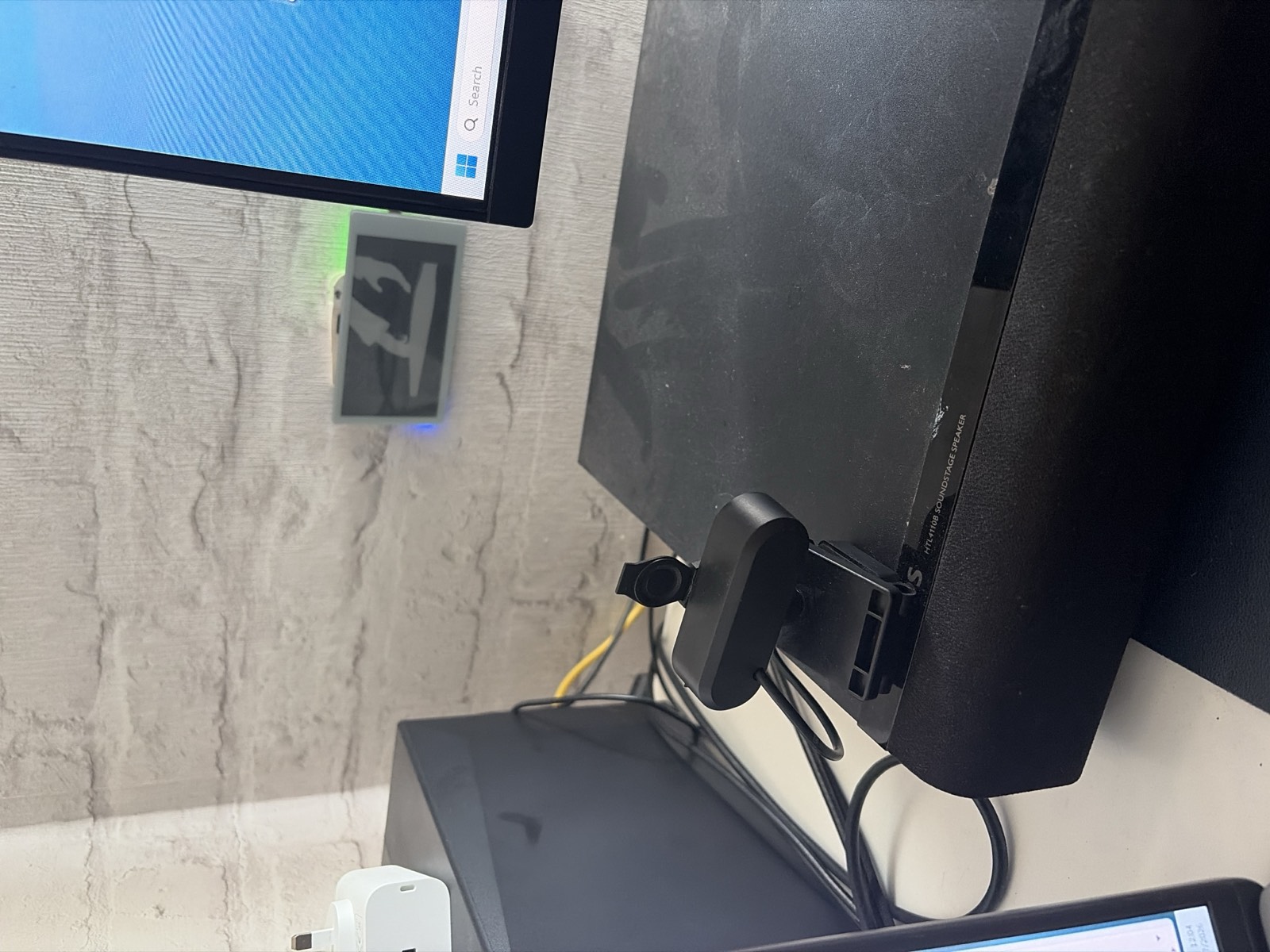
So here it is. A stripped-down spare panel is looping Bad Apple around the clock while a webcam photographs it once a minute — this page shows the latest frame, for as many days as the glass holds out.
01What you are looking at
The photo above is a real webcam pointed at an e-paper panel running the same driver as the Bad Apple write-up — but it isn't the same board. This one is a cheaper, stripped-back LilyGo H716 (no battery, no GPS, no case), a spare that never went into service, which makes it the ideal candidate for the chopping block. Driven over its parallel bus at 20 fps, it plays the video on a loop and never stops. Somewhere in the region of six days of continuous playback, the pixels that flip most often should start to fade, ghost, or stick. When they do, you'll see it here before anywhere else.
02How it is measured
There is no clever telemetry — just a camera and a clock. A cron job on the NAS grabs one frame a minute straight off a USB webcam and drops it here; the counter is dead reckoning from the start time, assuming an unbroken 20 fps:
elapsed × 20 fps  =  estimated pixel refreshes
10,000,000 refreshes ÷ (20 × 3600)  ≈  139 hours  ≈  5.8 days
So the numbers below are an upper bound on wear — they trust that the panel really is painting every frame, every second. The webcam is the honest witness: whatever the glass actually does, the photo shows it.
03Rewind the experiment
Every frame is archived, then thinned as it ages: one a minute for the last hour, one every ten minutes for the last day, and one an hour for the last week. Drag the slider to scrub back through the panel's life and watch for the first signs of wear.
The build: see Bad Apple at 20 fps on a $71 e-paper display for how the driver works, and github.com/tonywestonuk/EPD_Painter for the code.
Sacrificial board: a bare, cheaper LilyGo H716 — no battery, GPS, or case, a spare that was never put into service. The write-up itself was built on the LilyGo T5 E-Paper S3 Pro / M5PaperS3. Test rig and webcam by Tony Weston.